
Jane Austen's True Grace:
Some thoughts on Pride and Prejudice (1813).

Like Wollstonecraft’s ‘true grace’—the independence of mind she so valued in women—Austen connects ‘real power’ throughout her novel not with social standing, but with ‘intelligence […] wit,’ and ‘critical attitudes’.
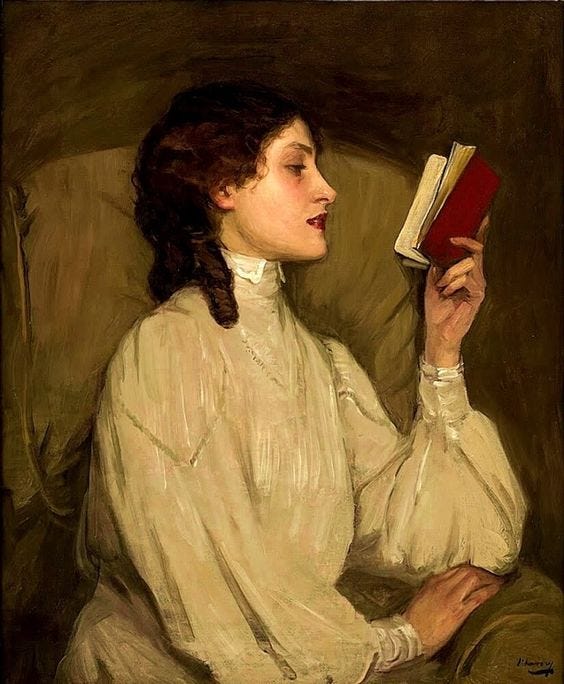
The first iteration of Pride and Prejudice (1813) was First Impressions, written during the 1790’s. Although this version of the text was rejected for publication, this detail confirms that Austen’s novel was being written and worked on during the height of the revolutionary author Mary Wollstonecraft’s campaign for women’s rights. Indeed Wollstonecraft’s seminal text, A Vindication of the Rights of Women, was only published in 1792. Austen appears to have been well acquainted with these contemporary discussions, as ‘[k]ey terms’ derived from the ‘embattled vocabulary’ within ‘debates about women play constantly’ throughout the final version of Austen’s novel, Pride and Prejudice.1 This vocabulary becomes apparent during a key interaction in the text’s first quarter, as Elizabeth finds herself refusing a proposal of marriage from a family acquaintance, Mr. Collins.
A clergyman with ‘a good houseand very sufficient income’,2 as well as an inflated social status through the patronage of the wealthy Lady Catherine De Bourgh, Mr. Collins cannot believe that Elizabeth could possible reject his advances. Well-versed in contemporary manuals on women’s conduct, he initially describes her refusal as merely ‘the usual practice of elegant females’, insisting that she secretly wishes for him to persist further.3 Elizabeth responds by rejecting his characterisation of her as an ‘elegant female’ somehow devoid of sense, considering herself instead as ‘a rational creature speaking the truth from her heart’.4 Austen’s usage of ‘rational creature’ appears to be lifted straight out of Wollstonecraft, who uses the term fourteen times during her explosive Vindication.5 Wollstonecraft contrasts her view of women as ‘rational creatures’ with those who, like Mr. Collins, would treat women ‘as if they were in a state of perpetual childhood’.6
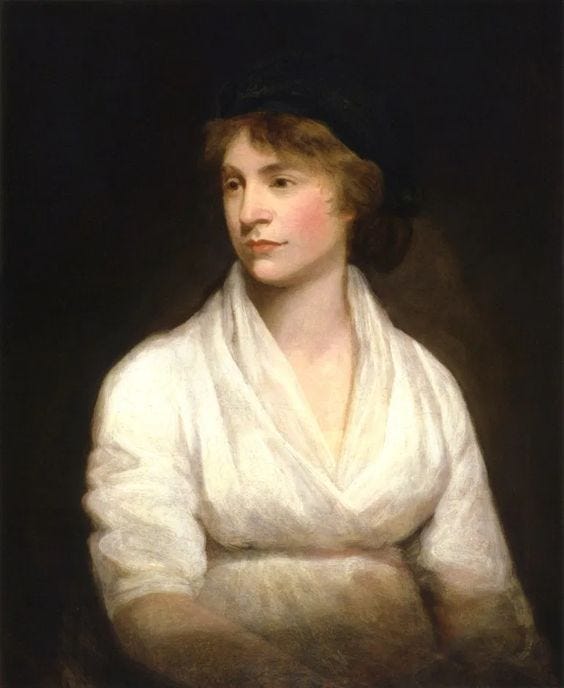
Indeed, throughout the novel, Austen consistently undermines the established view of English society regarding the rational inequality of the sexes. Reverend Fordyce’s conduct manual, Sermons to Young Women (1766), which by Austen’s time was an expected addition to a young woman’s library, is ruthlessly mocked by her characters. The main promotor of these sermons is Mr. Collins, a man described by Mr. Bennet as ‘absurd’,7 and by the narrator as ‘not a sensible man’, who indeed presented a ‘deficiency of nature’ (that is, low intelligence).8 During a family dinner, as Mr. Collins began to read from the Sermons, Elizabeth’s sister, Lydia, ‘gaped as he opened the volume,’ and ‘before he had […] read three pages’ was forced to interrupt him.9 Austen, in her treatment of Fordyce, seems to mirror Wollstonecraft, who in her Vindication describes the Sermons as likely to ‘hunt every spark of nature out of [a girl’s] composition’.10 Through her fiction, Austen appears to undermine this designation of women as feeling and men as reasoning, a distinction common in English society during the late eighteenth century. Indeed, Austen critics have emphasised that Elizabeth’s ‘wit and intelligence’ are portrayed ‘in a particularly free and exuberant manner’,11 her disposition consistently charged through with ‘energetic expression’ and ‘critical energies’.12
Additionally—and no doubt some of you Austinites have already heard of this—Austen is able to express the rich inner life of her protagonist through the utilisation of the unique literary technique, ‘free-indirect discourse’ (which Austen critic, John Mullan, has credited to her invention).13 Free indirect discourse is a ‘technical term’ describing how ‘the narrator moves freely and flexibly into and out of the minds of her characters’,14 in this case allowing for Austen to fluidly present Elizabeth’s inner liveliness of mind. The narrator often describes Elizabeth’s ‘agitating reflections’;15 her ruminating for ‘hours’ at a time, ‘giving way to every variety of thought; reconsidering events [and] determining probabilities’.16
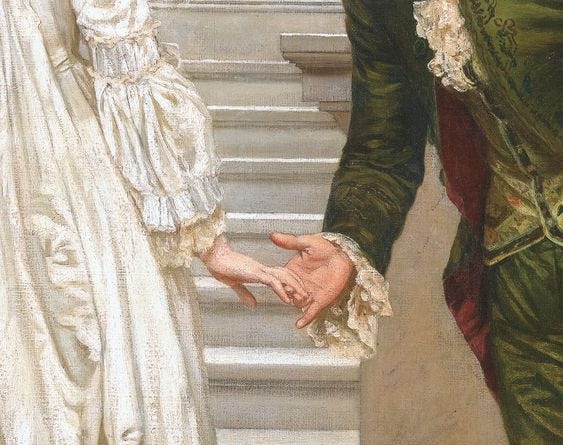
This lively intelligence is reinforced by Elizabeth’s main love interest, Mr. Darcy, a wealthy man of marriageable age. Of particular interest for weighing Austen’s political and moral views regarding the role of women in society, Mr. Darcy admires Elizabeth precisely not for those qualities so praised by contemporary authorities on female psychology. The evangelical writer, Hannah More, for instance, in her Strictures on the Modern System of Female Education (1799), reasserts Fordyce’s thesis. 17 A woman who wants to be happy, she writes, ‘should be led to distrust their own judgement [and] acquire a submissive temper’.18 Anglican priest, Thomas Gisborne, similarly contends in Enquiry in the Duties of the Female Sex (1797), that a woman’s ‘glory’ is to be found (apparently only) in ‘delicacy […] and tenderness’.19 Mr. Darcy, by contrast, confesses that he loved Elizabeth most for ‘the liveliness of [her] mind’.20 Like Wollstonecraft’s ‘true grace’—the independence of mind she so valued in women—Austen connects ‘real power’ throughout her novel not with economic or social standing, but with ‘intelligence […] wit,’ and ‘critical attitudes’.21
Bibliography:
Austen, Jane. Pride and Prejudice, Revised Edition. London: Penguin Classics, 2014.
Bennet, Andrew, Royle, Nicholas. This Thing Called Literature: Reading, Thinking, Writing. London: Routledge, 2015.
Fordyce, James. Sermons to Young Women. London: Printed for A. Millar and T. Cadell, J. Dodsley, and J. Payne, 1766.
Gisborne, Thomas. An Enquiry into the Duties of the Female Sex. London: Printed for T. Cadell and W. Davies, by W. Bulmer and Co., 1813.
Jones, Vivien. Introduction to the Penguin Edition of Pride and Prejudice, Revised Edition. London: Penguin Classics, 2014.
More, Hannah. Strictures on the Modern System of Female Education. London: Published by Samuel West, 1799.
Newton, L. Judith. “Pride and Prejudice”: Power, Fantasy, and Subversion in Jane Austen. Feminist Studies, Vol. 4, No. 1 (Feb 1978), 27-42.
Oxford Academic (Oxford Academic University Press). Jane Austen’s Writing Style and Voice. YouTube: Oxford University Press, 2018.
Wollstonecraft, Mary. A Vindication of the Rights of Women. Kindle Edition. Seattle: Amazon Classics, 2018.
Footnotes:
Jones, Introduction to Pride and Prejudice, xix
Jane, Austen. Pride and Prejudice, Revised Edition. London: Penguin Classics, 2014, 69.
Austen, Pride and Prejudice, 106.
Austen, Pride and Prejudice, 106, emphasis added.
Wollstonecraft, Vindication, 12, 18, 46, 47, 52, 58, 68, 77, 81, 83, 99, 123, 191, 239.
Wollstonecraft, Vindication, 12.
Austen, Pride and Prejudice, 67.
Austen, Pride and Prejudice, 69.
Austen, Pride and Prejudice, 67.
Wollstonecraft, Vindication, 121.
Judith, L. Newton. “Pride and Prejudice”: Power, Fantasy, and Subversion in Jane Austen. Feminist Studies, Vol. 4, No. 1 (Feb 1978), 34.
Newton, Power, Fantasy, and Subversion, 35.
Oxford Academic (Oxford Academic University Press). Jane Austen’s Writing Style and Voice. YouTube: Oxford University Press, 2018.
Andrew, Bennet, and Nicholas, Royle. This Thing Called Literature: Reading, Thinking, Writing. London: Routledge, 2015, 47.
Austen, Pride and Prejudice, 189.
Austen, Pride and Prejudice, 203.
Hannah, More, Quoted by Jones, Introduction to Pride and Prejudice, xvii.
Hannah, More, Quoted by Jones, Introduction to Pride and Prejudice, xix.
Thomas, Gisborne, Quoted by Brown, Austen and the Feminist Tradition, 325.
Austen, Pride and Prejudice, 359.
Newton, Power, Fantasy, and Subversion, 34.